Physical Address
304 North Cardinal St.
Dorchester Center, MA 02124
Physical Address
304 North Cardinal St.
Dorchester Center, MA 02124

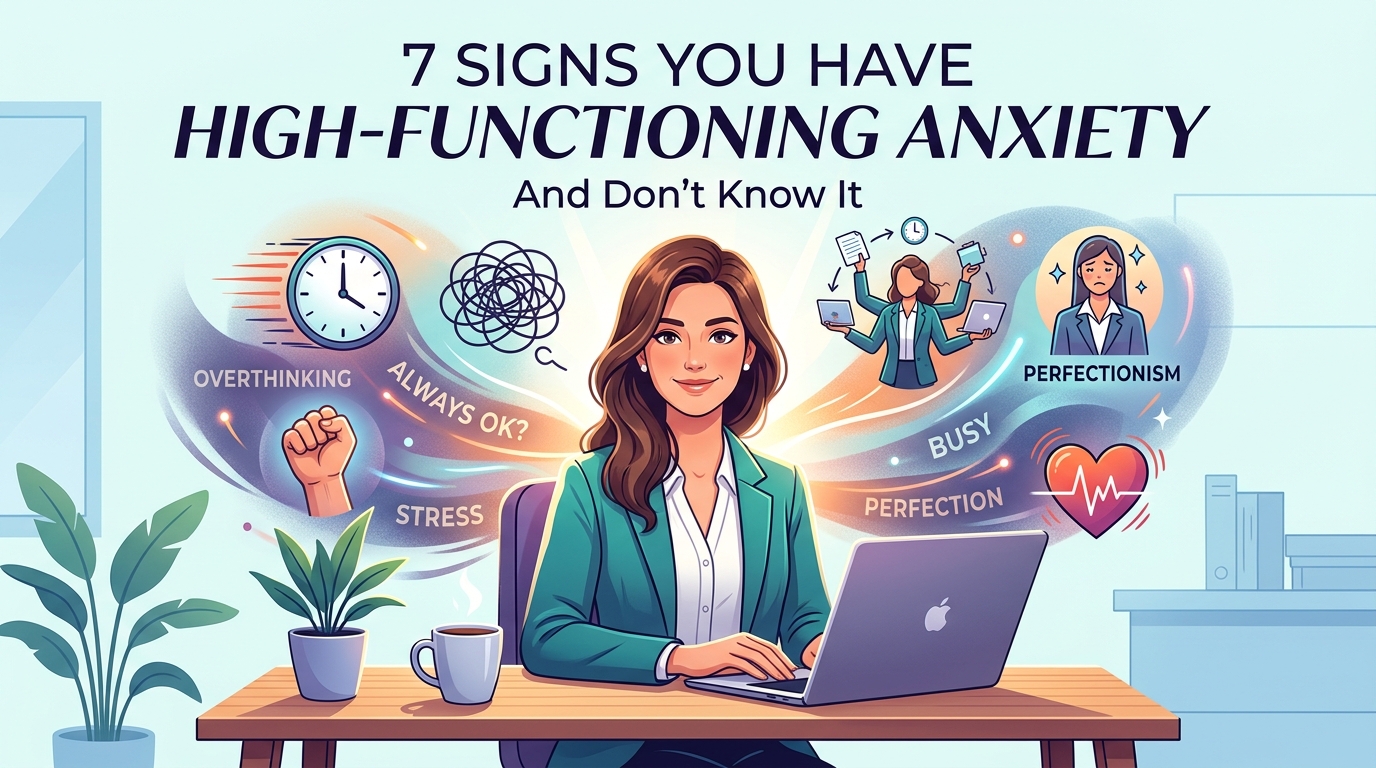
You meet someone who seems to have everything together. They are productive, reliable, always on time, and appear calm under pressure. What most people never see is the relentless internal storm that never fully quiets.
High-functioning anxiety describes people who experience significant anxiety symptoms but continue to function — and often excel — in their daily lives. A 2023 study found that 44% of the US population experienced anxiety symptoms — but 11.5% of them did not even recognize they had anxiety. They simply thought they were stressed or driven.
If any of the following signs feel familiar, you may be carrying more than you realize.
This is the hallmark of high-functioning anxiety — a brain that never truly powers down. You replay conversations looking for things you said wrong. You plan for every possible outcome before a meeting. You rehearse difficult situations repeatedly in your head even when everything went fine.
Persistent “what-if” worry and mental rehearsal keep looping even when you are outwardly calm. Perfectionistic concerns — the feeling that nothing you do is ever good enough — and a strong fear of failure fuel over-preparation or last-minute procrastination.
Most people around you see focus and diligence. What is actually happening is your brain running worst-case scenarios on a continuous loop that you cannot switch off.
From the outside, your work ethic looks admirable. You meet every deadline, take on extra responsibilities, and rarely say no. But the fuel behind all of that productivity is not excitement — it is fear.
The very traits that help you succeed are often fueled by anxiety. Your attention to detail is driven by fear of making mistakes. Your work ethic is powered by worry about falling behind. Your reliability is motivated by dread of disappointing others.
This distinction matters because it means that no amount of success actually relieves the anxiety. Every goal completed is immediately replaced by the next one, and the fear of failure begins all over again.
People with high-functioning anxiety often find genuine rest almost impossible. Sitting still, taking a day off, or doing nothing productive triggers a creeping guilt that is difficult to shake.
People with high-functioning anxiety struggle with difficulty relaxing. Despite appearing outwardly successful, they find it nearly impossible to truly relax and recharge. This perpetual state of hypervigilance can lead to burnout, exhaustion, and a diminished quality of life over time.
If you find yourself unable to enjoy a rest day without mentally drafting your to-do list, or feel vaguely guilty whenever you are not being productive, this is not a personality quirk. It is a symptom.
Physiology often speaks first — even before the mind catches on. Muscle tension, jaw clenching, and tension-type headaches correlate strongly with anxious arousal. Nervous stomach, nausea, IBS flares, or appetite swings when stress rises are also common — brain-gut axis reviews show anxiety heightens digestive sensitivity. Sleep stuck in a constant “on” mode, replaying to-do lists at 2am, struggling to fall asleep, or waking wired at 4am are also firmly linked to this pattern.
If you have visited doctors about these symptoms and been told nothing is physically wrong, anxiety may be the explanation. Treating the underlying anxiety often resolves the physical symptoms entirely.
High-functioning anxiety is often overlooked because those who experience it can still function and meet societal expectations. Many individuals with high-functioning anxiety may not recognize their symptoms or may perceive them as normal stress, leading to a delay in seeking professional help.
This is what makes it so hard to catch. You have become expert at projecting calm while running on empty internally. Others rarely notice. You rarely mention it. And so it continues, unnamed and unaddressed, for years.
Despite your track record of success, you are convinced you are a fraud. Research from Korn Ferry found that 71% of CEOs experience imposter syndrome — proving that achievement does not eliminate self-doubt. You attribute your successes to luck, timing, or fooling people. The fear of being “found out” keeps you working harder than necessary to prove yourself.
The cruel irony is that the harder you work to prove yourself, the more convinced you become that the success is not real. High-functioning anxiety creates a treadmill of achievement that never actually arrives at confidence.
Small delays trigger outsized anger or tears — classic signs that cognitive bandwidth is maxed out. Overwhelm in busy spaces, bright lights, loud environments, or packed schedules can push you toward shutdown.
If an unexpected change in plans, a delayed response to a message, or a minor setback causes a reaction that feels out of proportion — and you often feel embarrassed by that reaction afterward — this is your nervous system telling you it is already running at capacity.
Cognitive Behavioral Therapy is considered the gold standard in treating anxiety disorders, with strong evidence of efficacy in clinical trials and effectiveness in real-world settings. Meta-analyses have shown CBT consistently helps reduce anxiety symptoms across disorders — including high-functioning anxiety — by reshaping unhelpful thought patterns and behaviors.
If several of these signs feel familiar and have been present for six months or longer, speaking with a mental health professional is the most important step you can take. High-functioning anxiety is treatable — but only when it is first recognized for what it is.
Disclaimer: This content is for informational purposes only and does not constitute medical or psychological advice. Always consult a qualified healthcare professional for guidance specific to your situation.