Physical Address
304 North Cardinal St.
Dorchester Center, MA 02124
Physical Address
304 North Cardinal St.
Dorchester Center, MA 02124

Most people treat sleep as the first thing to cut when life gets busy. Work runs late, phones stay on, and seven hours quietly becomes five. It feels manageable — until it doesn’t.
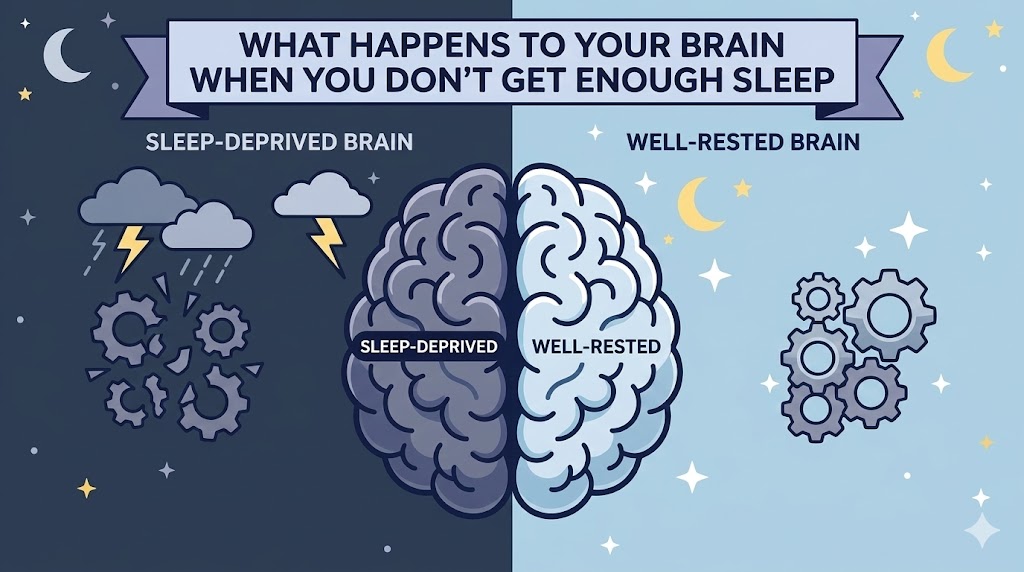
What most people do not realize is that sleep deprivation is not just tiredness. It is your brain being physically altered, one night at a time. The research on this is not mild. It is alarming — and most people have no idea it is happening to them.
Here is exactly what science says is going on inside your brain when you are not sleeping enough.
Before getting into what goes wrong, it helps to understand what sleep is actually for. Your brain is not simply resting when you sleep — it is working hard.
During sleep, your brain forms new pathways to help you learn and remember information. It is preparing for the next day — improving your ability to pay attention, make decisions, and be creative.
Sleep is also when your brain cleans itself. The glymphatic system — a network responsible for flushing waste products out of the brain — is most active during sleep. Poor sleep quality disrupts this system, which plays a crucial role in maintaining brain health.
Skip sleep, and none of this happens properly. Here is what that costs you.
This is one of the most disturbing findings in recent sleep research — and it comes directly from MIT.
A new study from MIT reveals that during lapses of attention caused by sleep deprivation, a wave of cerebrospinal fluid flows out of the brain — a process that normally occurs during sleep and helps wash away waste products that have built up during the day.
In other words, when you are sleep deprived and your attention suddenly drops out, your brain is not malfunctioning. It is briefly trying to do what it should have done overnight — clean itself. But it can only do that by temporarily shutting down your focus.
When someone is sleep-deprived, the body appears to try to make up for lost rest by triggering bursts of this fluid movement during wakefulness — and each time this happens, attention fails as the brain prioritizes self-maintenance over focus.
You cannot willpower your way through this. It is a physical process happening without your permission.
When you do not get enough quality sleep, decreased signaling across your brain diminishes functions including memory. Over multiple sleepless nights, sleep deprivation reduces your ability to form long-term memories.
Poor sleep impairs memory consolidation by disrupting the normal process that draws on both NREM and REM sleep for building and retaining memories. Studies have even found that people who are sleep deprived are at risk of forming false memories.
That last point is worth sitting with — sleep deprivation does not just make you forget things. It can cause your brain to manufacture memories of things that never happened.
This finding is one of the most striking in recent sleep science. It is not metaphorical aging — it is measurable, structural aging of the brain itself.
Research from the University of Zurich found that a single night without sleep causes the brain to appear one to two years older than a person’s actual age, based on MRI scans analyzed with machine learning tools.
Long-term sleep loss has also been linked to neurological damage in the hippocampus — the brain region most responsible for learning and memory — and increased risk for Alzheimer’s and other neurodegenerative diseases.
One bad night ages your brain by two years. Consider what months or years of poor sleep does cumulatively.
Sleep deficiency changes activity in parts of the brain responsible for decision-making. If you are sleep deficient, you may have trouble making decisions, solving problems, controlling your emotions and behavior, and coping with change. Sleep deficiency has also been linked to depression, suicide, and risk-taking behavior.
This explains something many people notice but cannot explain — why they feel emotionally raw, irritable, or impulsive after poor sleep. It is not weakness or mood. It is your prefrontal cortex — the part of the brain that regulates emotion and judgment — being deprived of the restoration it needs to function.
This is perhaps the most important long-term consequence of chronic sleep deprivation, and the least talked about.
Research from the University of Hong Kong found that poor sleep quality adversely affects normal brain function by deactivating the restorative glymphatic system. The results clearly reveal that sleep quality affects the brain’s network through the glymphatic system, which in turn affects memory performance.
When the glymphatic system stops working efficiently, toxic waste products — including proteins linked to Alzheimer’s disease — accumulate in the brain instead of being cleared out. This is not a risk that appears decades from now. It begins accumulating with every night of poor sleep.
Here is the problem with sleep deprivation that makes it particularly dangerous: after several nights of losing sleep — even a loss of just one to two hours per night — your ability to function suffers as if you have not slept at all for a day or two.
And yet most sleep-deprived people believe they are functioning fine. The part of the brain responsible for self-assessment is one of the first things impaired by sleep loss — so you lose the ability to accurately judge how impaired you are.
The research is clear — there is no supplement, no productivity hack, and no amount of caffeine that replaces what sleep does for your brain. The recommendations from sleep scientists are consistent: seven to nine hours of actual sleep per night for adults, in a dark, cool room, with screens off at least 30 minutes before bed.
For people with sleeping problems, improving sleep quality offers a practical way to enhance cognitive performance. Brands Professional That means the single most effective thing you can do for your brain health, your memory, your mood, and your long-term cognitive function costs nothing and requires only one decision — going to bed earlier tonight.
Your brain has been asking you for this. Now you know why.
Related Articles:
Disclaimer: The content on Brandsprof.com is for informational purposes only and does not constitute medical advice, diagnosis, or treatment. Always consult a qualified healthcare professional before making any health decisions.