Physical Address
304 North Cardinal St.
Dorchester Center, MA 02124
Physical Address
304 North Cardinal St.
Dorchester Center, MA 02124

It happens like clockwork. You fall asleep without difficulty, and then at some point in the early hours your eyes open. The room is dark. You already know what time it is before you look. 3am. Again.
Most people blame stress, or a noisy street, or getting older. The real explanation is more fascinating — and more fixable — than most people realize.
This is not a coincidence. There is a specific biological reason why early morning wake-ups cluster around 3am for so many people.
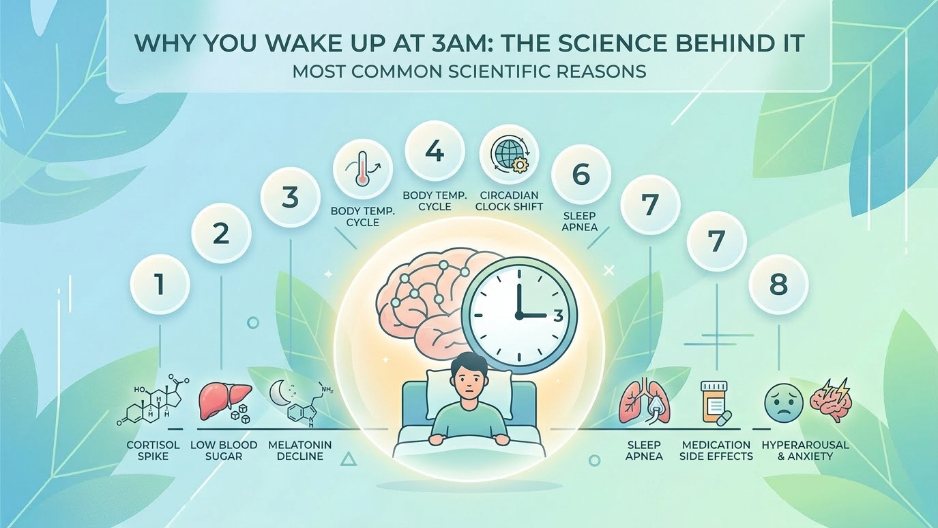
One of the key players behind early-morning waking is cortisol — often called the stress hormone, but more accurately a hormone that helps the body prepare for the day. Cortisol starts to rise between 2 and 3am, increasing gradually until it peaks about 30 to 45 minutes after you wake up. This rise helps the body prepare for the day by increasing alertness, blood sugar, and energy availability.
Under normal circumstances, you sleep right through this. But when you are under stress, or when your sleep architecture has been disrupted, this early cortisol rise can feel like a jolt — pulling you out of sleep before you are ready. Studies show that people with insomnia often have an earlier and steeper cortisol rise, especially if they are under chronic stress.
Your brain cycles through different stages of sleep in roughly 90-minute intervals. Early in the night, you spend more time in deep sleep. But as the night progresses — typically around 3 to 4am if you went to bed around 10 or 11pm — you spend more time in lighter REM sleep. This lighter sleep makes you more susceptible to waking from minor disruptions: a car driving by, your partner shifting position, or your cortisol beginning its natural rise.
This means the 3am window is when you are at your most vulnerable to waking — biologically, consistently, regardless of what else is happening in your life.
A common cause of 3am waking is a dip in blood glucose. When glucose levels drop too low overnight, the body releases cortisol, adrenaline, and glucagon to correct it — and that hormonal surge often jolts you awake in the process. This is especially common in people with poor glycemic control or insulin resistance and is known as the Somogyi Effect.
Both alcohol and late-night meals disrupt melatonin production, increase core body temperature, and impair deep sleep. Alcohol acts as a diuretic and inhibits gluconeogenesis — the liver’s glucose production mechanism — which can cause a blood sugar drop several hours after drinking, triggering the early morning awakening cascade.
Stress and anxiety keep the body in a heightened state of alert. The middle of the night — when there are no distractions — is prime time for worry to spiral. People with anxiety disorders, PTSD, or depression are especially prone to nighttime awakenings.
The reason this feels more intense at 3am than it did when you went to bed is because the inhibitory effect of deep sleep has worn off, and your conscious mind has nothing to compete with the anxiety — no tasks, no conversations, no distractions. It is just you and the thoughts your brain has been waiting to surface.
Bodies can be surprisingly predictable. At one point, you may have had a reason to wake up at that time — in response to sleep apnea, a crying baby, or a period of stress. Your body becomes conditioned to it, and continues waking at that time long after the original cause has passed.
This conditioned awakening is one of the most common explanations for consistent 3am wake-ups in people who otherwise sleep well and have low current stress. The body has simply learned a pattern.
If you wake at 3am, give yourself 15 to 20 minutes to fall back asleep. But if you are awake longer than that, get out of bed instead. When you feel frustrated that you cannot fall back to sleep, lying in bed awake reinforces the association between your bed and wakefulness, making the pattern worse.
For ongoing 3am waking, the most effective practical changes are:
Finish eating at least three hours before bed to stabilize overnight blood sugar. Avoid alcohol within four hours of sleep. Keep your bedroom cool — the ideal temperature is between 60 and 67 degrees Fahrenheit. Establish a consistent bedtime and wake time, including weekends.
For women over 55, the hormonal shifts of menopause are one of the most common drivers of early morning waking. Drops in estrogen and progesterone directly disrupt sleep cycles. Speaking to a doctor about menopause-related sleep disruption is an important step that many women delay unnecessarily.
If consistent 3am wake-ups are causing daytime fatigue, difficulty concentrating, or emotional distress, speak to a doctor. Sleep apnea, in particular, is frequently undiagnosed and is one of the most treatable causes of disrupted sleep.
Related Articles:
Disclaimer: This content is for informational purposes only and does not constitute medical advice. Consult a qualified healthcare professional for persistent sleep difficulties.